The art of borrowing: why your friend’s stuff is cooler than yours
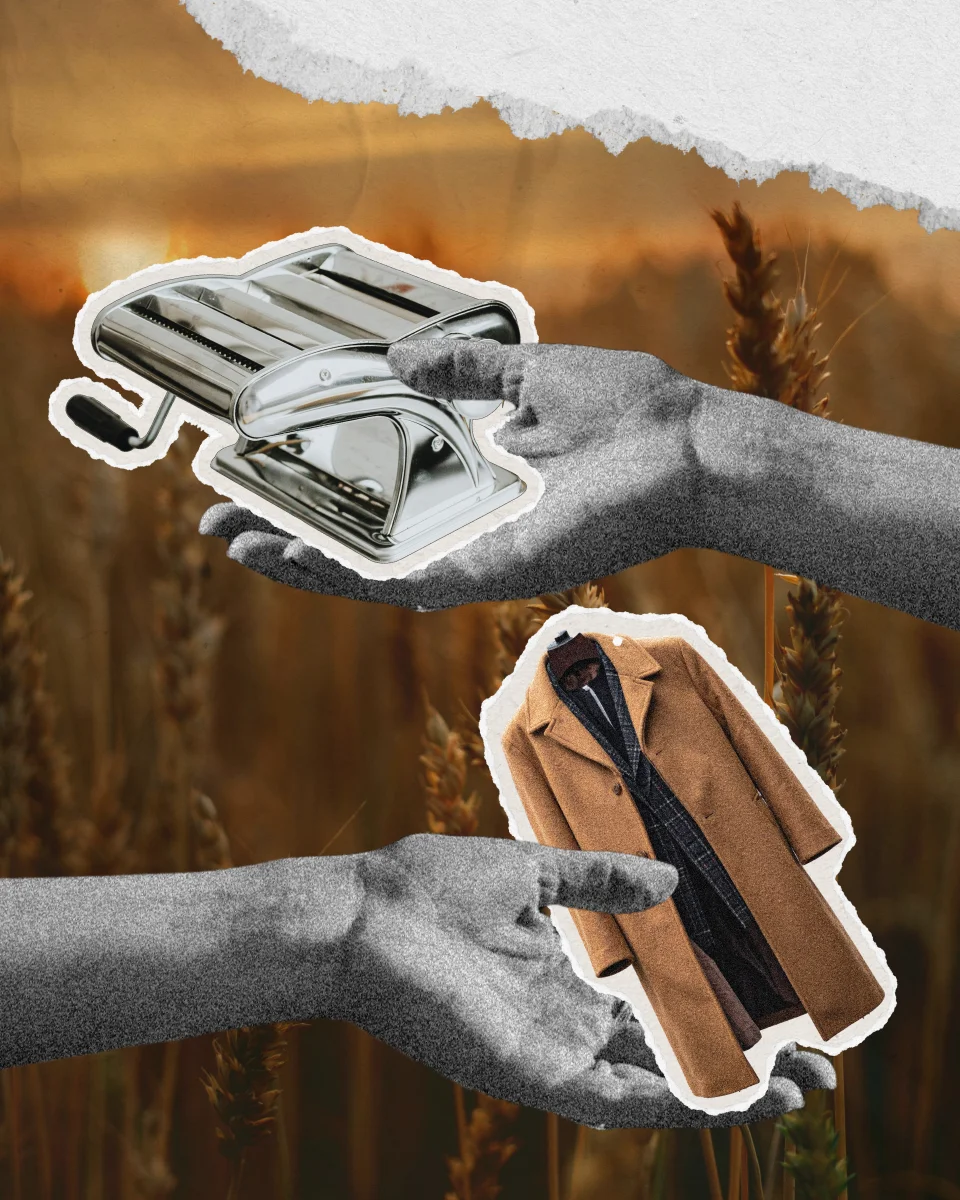
There is something undeniably magnetic about other people’s belongings.Your friend’s oversized blazer? Effortlessly chic, somehow. Their pasta maker? Totally suggests a life where you serve your friends handmade tagliatelle at dinner parties. Their camping gear? You’re one borrowed tent away from becoming someone who ‘does nature.’
Your own versions of these things, meanwhile, sit in a cupboard collecting dust.
This is not an accident. We grow attached to what we own, but we also stop really seeing it, and it fades into the background of our attention. Other people’s things still feel charged with possibility. They feel fresh. Interesting.
And that difference – that tiny psychological glitch – might be one of the most underused tools in sustainable living.
The novelty problem
Much of modern consumption isn’t driven by need, but by novelty. We replace things not because they’re broken, but because they’ve stopped feeling interesting. The sweater still fits. The lamp still works. The bookshelf still stands. What’s missing isn’t function, but stimulation.
Buying something new temporarily restores that stimulation. But borrowing does something even better. It gives you novelty without giving you another thing to store. Reintroducing freshness without requiring production. Smart, right?
A borrowed object, although second hand, often feels brand spanking new again. The object in itself hasn’t changed, but the context has. And context, as it turns out, is often what we’re really shopping for.
Scarcity makes things interesting
Oddly enough, when you don’t own something: you actually start using it. A fondue set you bought five years ago might be somewhere in the back of a cupboard. But a fondue set you borrowed? That actually turns into a fondue night. And that fun projector? If it’s yours, it gathers dust next to old cables. If it’s borrowed, suddenly there’s a movie night. Even books behave differently when borrowed. You read them because they’re due back. Ownership is endless. Borrowing has a deadline.
When something is temporary, it becomes intentional. Owning things often diffuses their purpose. We buy them for a specific moment, and then that moment passes. Borrowing sharpens the moment. It gives the object a job to do and an exit.
Most sustainability advice focuses on cutting back: buy less, waste less, declutter. Borrowing shifts that focus. Instead of shrinking the number of things in circulation, it increases the number of people using them. You still get the satisfaction but without the environmental cost.
The quiet rebellion against accumulation
We live in a culture where adulthood is quietly measured in acquisition. You accumulate furniture, appliances, tools and backup versions of tools, just in case. And yet most of those ‘just in case’ items are barely used. Think about that drill that drills once a year, or the ice cream maker that performs twice.
Borrowing interrupts that pattern in a surprisingly practical way. Instead of every household owning the same rarely used objects, the objects move. A ladder travels, your waffle iron rotates and your friends’ green dress attends three weddings in one season.
But something else shifts too. We’re so used to asking: ‘Should I buy this?’ Borrowing replaces that with: ‘Does someone already have this?’ That small change reframes sustainability from a private discipline into a shared habit.
And on top of that borrowing adds context. A dress with history is more interesting than one bought in a rush. A book that comes with a recommendation is more compelling than one delivered by an algorithm. We don’t just want objects, we want the stories attached to them. And borrowing, almost incidentally, gives us both.
Sustainable math
Environmentally, the logic is straightforward: the most sustainable product is the one that already exists. Extending the life of what’s already been produced reduces demand for new extraction, new manufacturing and therefore new waste. (Read more about this benefit in this report of OLX, that shows how impactful extending the life of products is!).
But the more interesting shift is psychological. Borrowing introduces the idea that access can be enough and that needing something temporarily doesn’t mean needing it permanently.
That’s not always comfortable. There’s vulnerability in asking. There’s ego in wanting your own. Which is why borrowing works best when it feels mutual, not frugal.
How to start borrowing without sounding like a cheapskate
The key isn’t to announce a new ‘no-buy borrowing lifestyle’, but to make it normal. Start by offering first. ‘Hey, I have a projector if anyone ever needs one.’ Or: ‘I’m not using my camping stove this summer if someone wants it.’
Create circulation before you request it. Also: keep it casual. ‘Does anyone have a ladder I could borrow?’ sounds different than ‘I don’t want to buy one.’ The focus stays on access, not avoidance.
Needless to say that it’s important to return things well. Clean. On time. With cookies if appropriate. You catch our drift.
In a culture that equates independence with ownership, borrowing is a quiet reminder that participation can be richer than possession. And sometimes, yes – your friend’s stuff really is better.

Florine started out as an art critic, but that turned out to not be quite her thing. So, she did what any sensible person would do - packed her life (and family) into a tiny campervan and roamed the planet for seven years. Now back in the Netherlands, she’s juggling life as a strategic advisor for a Dutch non-profit, while also writing for magazines and platforms. When she’s not typing away, you’ll probably find her treasure-hunting at thrift stores to jazz up her tiny house by the sea. Or wandering outdoors, because apparently sitting still isn’t really her vibe.

.png)
.png)