
Sponge cities: what if cities could absorb rain instead of fighting it?
When it rains in most cities, the water has only one destination: the sewer. It rushes across asphalt, down drains and into pipes designed to carry it away as quickly as possible.
That system worked for decades. But as storms grow heavier and cities denser, the infrastructure that once kept streets dry is increasingly overwhelmed. Flooded roads, overloaded sewage systems and polluted rivers have become familiar scenes in many urban areas.
Part of the problem is simple: modern cities are built like waterproof surfaces. Concrete, asphalt and rooftops seal the ground, leaving rainwater nowhere to go.
But what if cities behaved differently, less like a funnel and more like a… sponge?
The problem hidden beneath our feet
For most of the past century, the logic behind urban water management was simple: get rainwater out of the city as quickly as possible.
Engineers built gutters, pipes and underground sewer systems designed to move water away fast. The faster the rain disappeared, the safer streets and buildings were thought to be. And for a long time, that system worked.
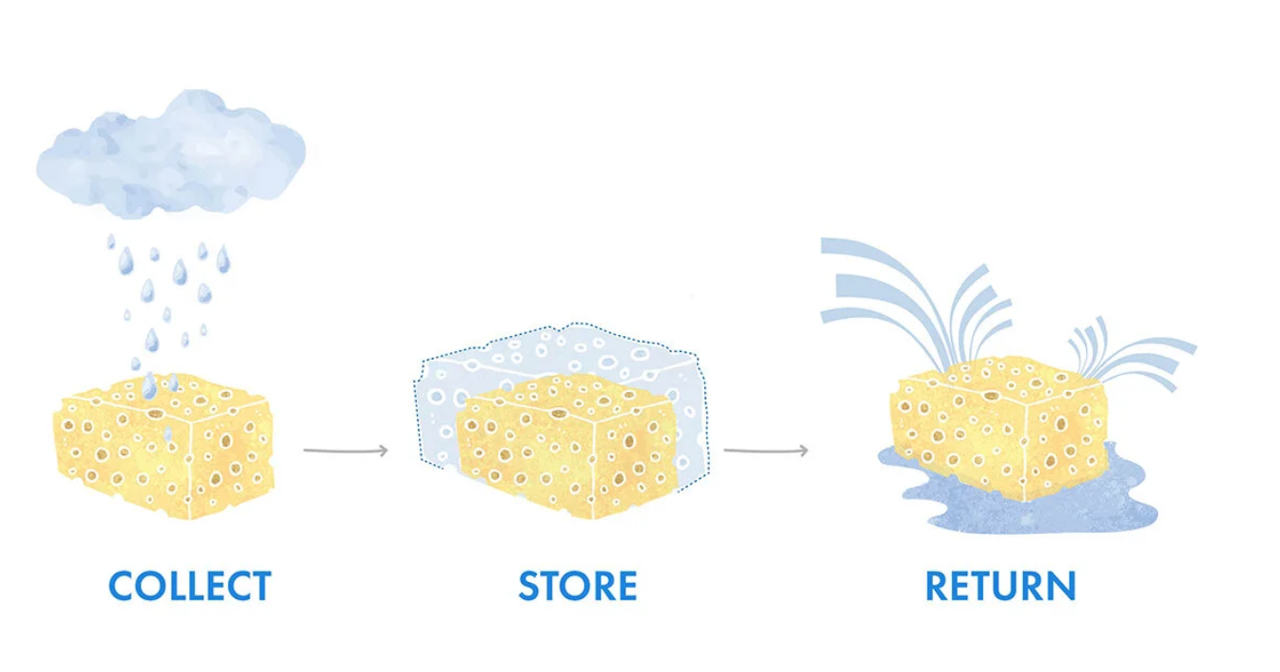
But cities have changed. They have grown denser, sealed with asphalt, concrete and rooftops that leave little exposed soil. At the same time, rainfall is becoming heavier and less predictable. The result is a system that was designed for a different kind of city and a different kind of climate. Sponge cities propose a different approach: instead of sending rainwater away immediately, they slow it down and give it space to be absorbed.
What a sponge city actually looks like
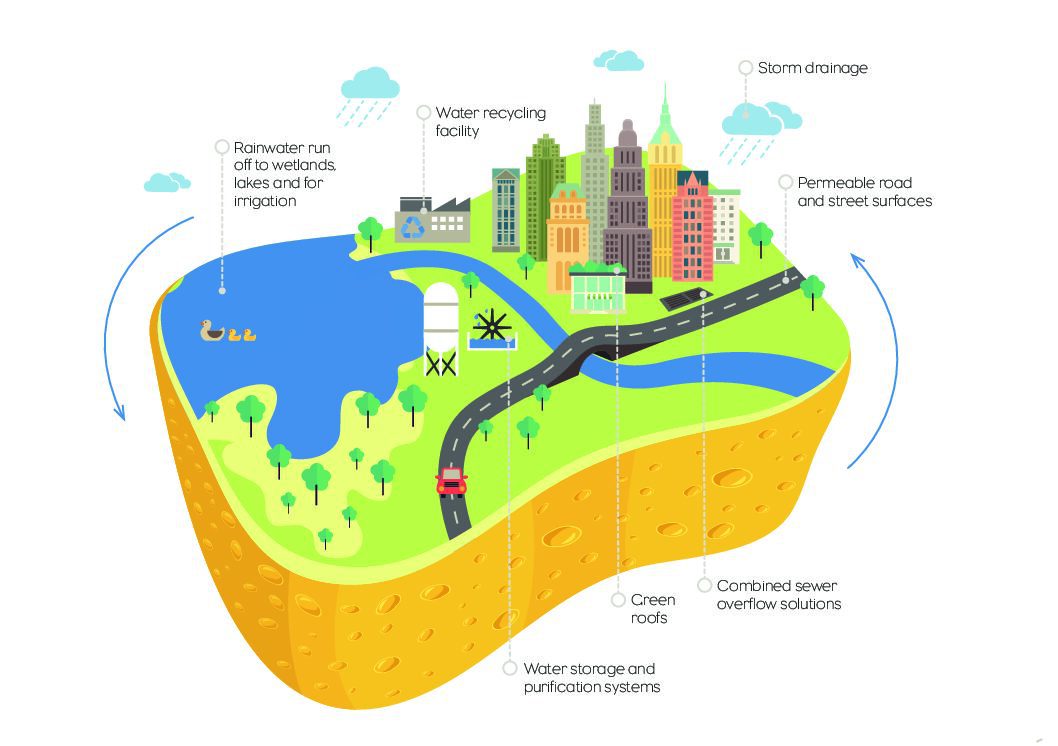
Despite the name, sponge cities don’t rely on giant sponges tucked under the streets (unfortunately). The idea is both simpler and greener: rooftops that absorb rain, parks that temporarily hold stormwater, and rain gardens that capture runoff instead of sending it straight into the sewer.
Even pavements can play a role: permeable materials allow water to slowly seep into the soil rather than bouncing off solid asphalt. None of these interventions are spectacular on their own, but together they form a network that slows rainwater down and gives it space to be absorbed, helping cities cope with storms that would otherwise overwhelm their drainage systems.
Cities that are already getting spongier
The concept gained global attention when China launched its Sponge City Program in 2015 after a series of severe urban floods. Dozens of cities began experimenting with ways to redesign streets, parks and entire neighbourhoods so they could better handle heavy rainfall.
The ambition is striking: by 2030, Chinese cities aim for around 80 percent of their urban areas to absorb and reuse most of their rainwater. That means parks that double as temporary water basins, residential areas designed to collect runoff, and green infrastructure woven throughout the urban landscape.
But China isn’t the only place experimenting with the idea. In Copenhagen, parts of the city have been redesigned to temporarily store water during extreme rainfall. Singapore integrates vegetation and water management throughout the city to capture and reuse rainwater. And in Rotterdam, the concept takes a particularly visible form.
Some public squares in the Dutch city are designed to temporarily fill with rainwater during heavy storms. Most of the time they function as basketball courts or meeting places. But when the rain comes, the square slowly turns into a basin, storing excess water until the drainage system can handle it again.
It’s a simple idea with a surprisingly big impact: instead of hiding water underground, cities begin making space for it.
More than just flood protection
While sponge cities are often discussed as a solution to flooding, their benefits go well beyond stormwater management.
Because they rely on plants, soil and open water instead of concrete and pipes, these interventions can also cool down cities during heatwaves. Green roofs and rain gardens reduce what urban planners call the ‘heat island effect,’ where built-up areas trap warmth and push temperatures several degrees higher than surrounding countryside. They also help filter polluted runoff before it reaches rivers and canals, improving water quality along the way.
And perhaps most importantly, sponge cities help store water for later use.
Many regions are expected to face growing water shortages in the coming decades. Instead of letting rainwater disappear into drains and rivers within minutes, sponge cities capture part of it, allowing it to seep into the ground and replenish groundwater supplies. In other words, the rain that once caused flooding may become part of the solution to future droughts.
Cities that are simply better places to live
But perhaps the most visible effect of sponge cities is simpler: they make cities more pleasant.
Rain gardens become small green oases along busy streets, parks that temporarily store water double as recreational spaces the rest of the year and green roofs that capture run off turn grey skylines into patches of vegetation.
Infrastructure that manages rainwater can also bring back trees, birds, shade and cooler streets. In other words, the same solutions that deal with rain can also make cities nicer places to live. Now isn’t that a classic win-win?

Florine started out as an art critic, but that turned out to not be quite her thing. So, she did what any sensible person would do - packed her life (and family) into a tiny campervan and roamed the planet for seven years. Now back in the Netherlands, she’s juggling life as a strategic advisor for a Dutch non-profit, while also writing for magazines and platforms. When she’s not typing away, you’ll probably find her treasure-hunting at thrift stores to jazz up her tiny house by the sea. Or wandering outdoors, because apparently sitting still isn’t really her vibe.





.png)
.png)